







STE provides specialized training and education in the field of fiber optic sensor technology for application in geophysical downholes. The program covers essential theoretical and practical knowledge and is structured into six modules.
The first module, titled “Introduction to Fiber Optics and Distributed Fiber Optic Sensing (DFOS) for Downhole Applications”, covers the fundamentals of optical fibers and DFOS technology in the downhole industry, their main advantages and challenges, as well as a comparison with traditional data acquisition technologies.
The second module is a workshop on geophysical optical fibers and cables, where field technicians receive hands-on training. The workshop includes an overview of passive and active fiber processing tools, and best practices for fiber preparation—especially the removal of protective coatings at high temperatures.
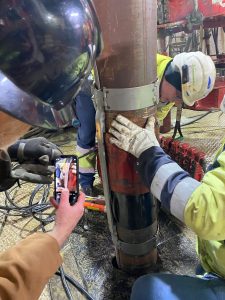
The third module, titled “Methods and Tools for Field Diagnostics of DFOS Systems”, focuses on testing and diagnostics of optical fibers, covering technologies such as Optical Time Domain Reflectometry (OTDR) and Optical Frequency Domain Reflectometry (OFDR). It provides a more detailed explanation of optical loss mechanisms and demonstrates reflectometry principles for evaluating losses in various scenarios.
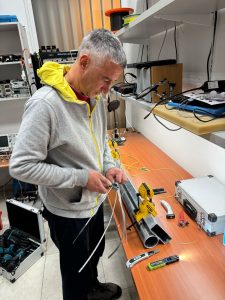
The fourth module, titled “Handling DFOS cables – principles, operation and maintenance” presents the manufacturing processes for thick- and thin-walled tubes and their impact on the final product and operations. It also covers types of steels for tubes and wires used in downhole applications, common tube geometries and their mechanical properties before and after manufacturing, and types of high-temperature-resistant polymers for sheathing, protective layers, fillers, and electrical insulation.
The fifth module, titled “Permanent, Semi-Permanent, Well-Intervention And Coiled Tubing DFOS – Planning, Preparation and Deployments”, teaches participants the differences between wireline and tubed DFOS solutions, cable preparation, fiber handling, measurement configurations (single-ended and double-ended), and techniques for optimal vibro-acoustic coupling. The module also covers electro-optical designs, safety protocols, and cable reach and weak-point planning.
The final, sixth module, titled “Distributed Fiber Optic Interrogation Technology for Downhole Industry – DTS, DAS, DTSS”, explains Rayleigh, Raman, and Brillouin scattering, the operation of DTS/DAS/DTSS systems, laser safety, and the advantages of different measurement configurations. It emphasizes the use of multi-physics measurements for better interpretation, handling large volumes of data, and basic analysis of real-world examples. The module includes sample cases for analysis and interpretation.
STE’s training, structured across these six modules, is not a theoretical collection of information but a systematically designed program that provides participants with a comprehensive understanding of how fiber optic sensing solutions function in downholes — from the physics of scattering and tube manufacturing processes, to field handling of fibers, diagnostics, and interpretation of DTS/DAS/DTSS data. As such, it brings added value to companies and professionals looking to reduce operational risks in the field and increase measurement reliability in a domain that is becoming a key technology for well monitoring and optimization.