






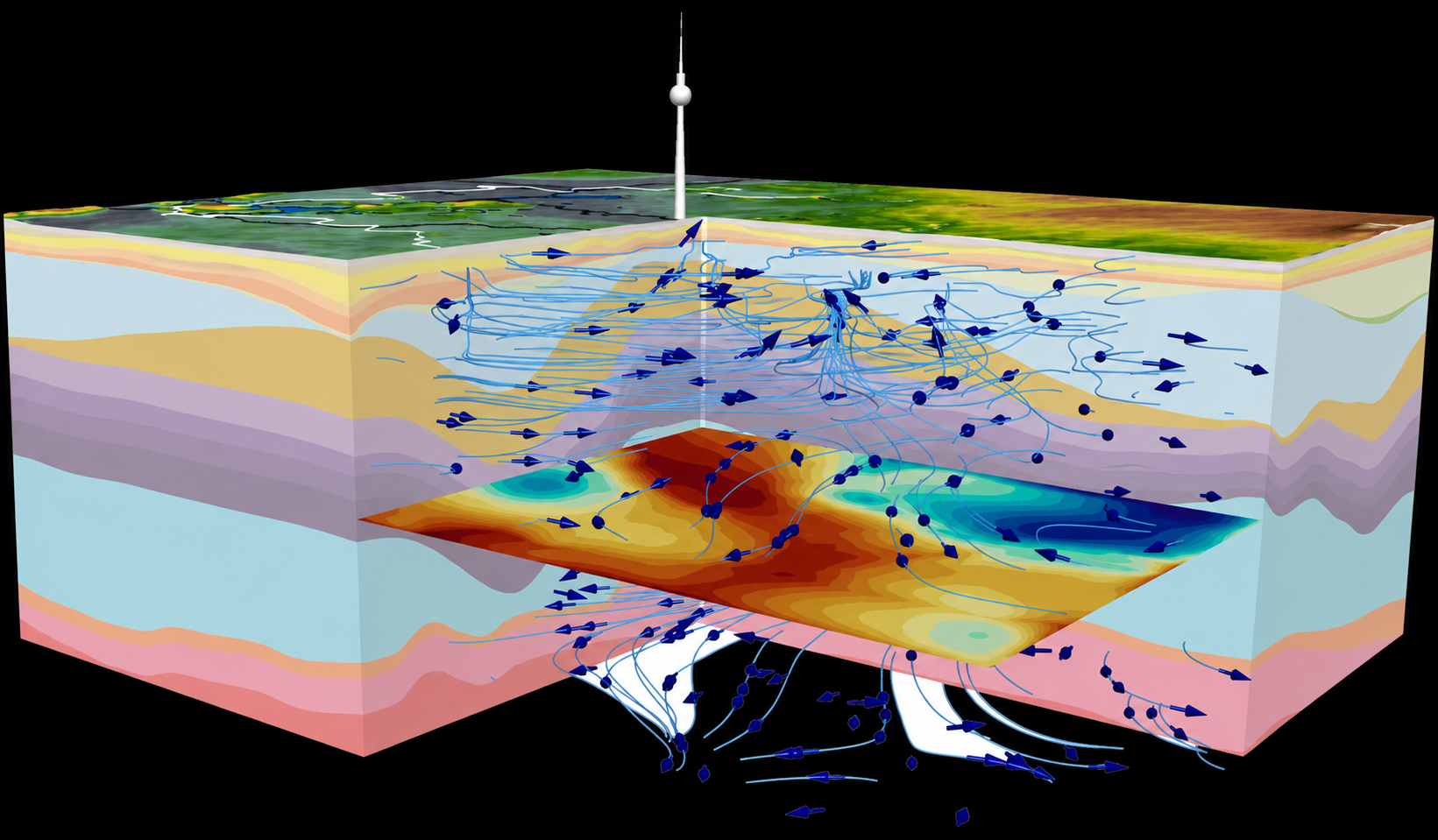
Geothermal energy is playing an increasingly important role in the decarbonization of Germany’s heating sector, particularly in urban areas. The most developed region is Bavaria, home to the Molasse Basin (Molassebecken), a geological structure that enables the efficient utilization of deep geothermal energy.
From the first project in Erding in the late 1990s to the present day, approximately 30 geothermal plants have been developed in Bavaria. Installed capacity has reached roughly 325 MW of thermal energy and 40 MW of electrical energy, representing the dominant share of geothermal energy production in Germany.
How Geothermal Energy Works
Depending on depth, geothermal energy is divided into shallow and deep geothermal systems. While shallow geothermal energy is used for heating and cooling individual buildings with the help of heat pumps, deep geothermal energy extracts heat from reservoirs located several kilometers underground, where temperatures exceed 65°C and, in some cases, even 100°C.
In Germany, the hydrothermal principle is used almost exclusively. In this approach, thermal water is extracted from underground reservoirs, utilized for heat transfer, and then reinjected into the reservoir through an injection well.
Applications and Energy Significance
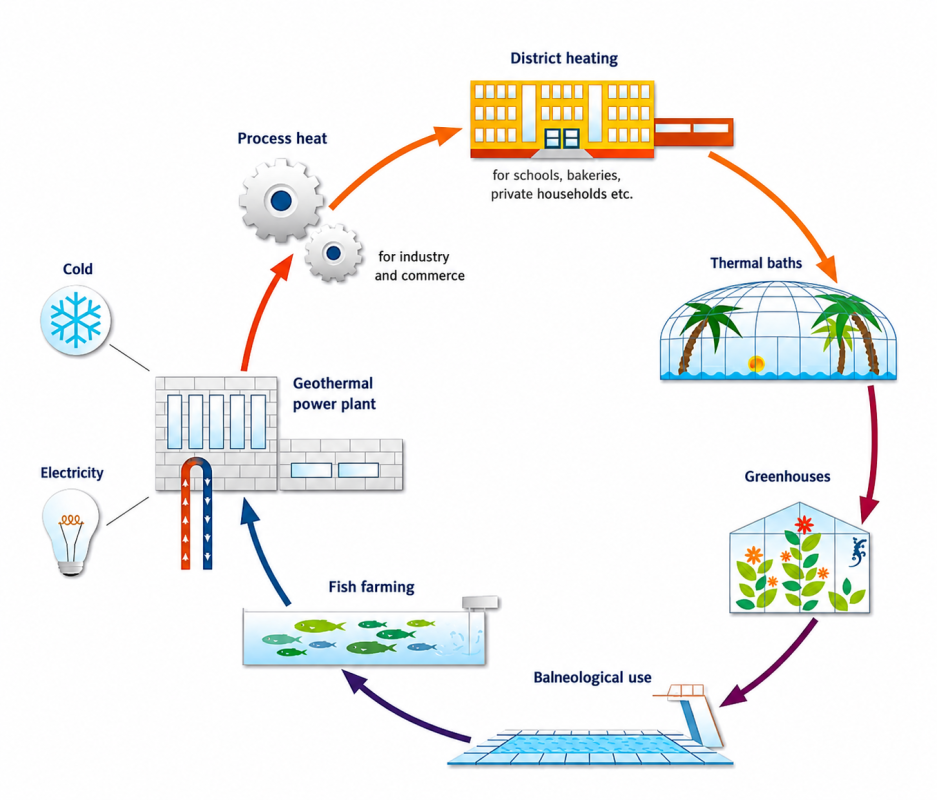
Deep geothermal energy is particularly suitable for district heating systems. Heat is transferred via heat exchangers into district heating networks, making it possible to supply entire urban districts, public buildings, and industrial facilities.
In areas with higher temperatures, electricity generation is also possible, with the thermal energy continuing to be utilized after electricity production. Additional value is created through cascading use, where the same energy can be sequentially applied for heating, industrial processes, or agricultural purposes.
Estimates indicate that deep geothermal energy in Bavaria could cover up to 40% of total heating demand while significantly reducing CO₂ emissions.
Key Development Challenges
Despite its considerable potential, the development of deep geothermal projects faces several challenges. The most significant are the high upfront drilling costs and the long investment payback period. Drilling costs can reach €1–1.5 million per kilometer of depth, while the total cost of equipment installation and commissioning can range between €12 and €18 million.
Another challenge is the so-called exploration risk: uncertainty regarding whether a well will encounter a suitable reservoir with sufficient temperature and flow rate. Geological conditions can vary significantly even within the same basin, directly affecting project success rates.
In some cases, microseismic events associated with water reinjection into the reservoir have also been recorded. However, these events are generally of low intensity and can be managed through adjustments to plant operations.
Baseline Assessment and the Role of Measurements
For every planned geothermal facility, it is essential to conduct a baseline assessment, meaning a detailed analysis of the specific site conditions. This process includes geophysical surveys, analysis of existing subsurface data, and evaluation of temperature, permeability, and groundwater availability. The quality of this information directly affects risk reduction and the economic viability of the project. In this context, advanced measurement methods are becoming a critical tool in geothermal development.
It is precisely in this segment that STE made its first significant contribution by participating as a partner in the “DEEEP” geothermal project in Vienna. Together with international partners, STE was involved in the planning and installation of a fiber-optic sensing system designed for the acquisition and monitoring of a reservoir with a maximum temperature of 120°C.
In addition, STE carried out measurements of the entire system, as well as initial measurements and monitoring of the cementing process of the concrete casing in both wells. Through this project, STE demonstrated that it possesses the necessary expertise and resources for fiber-optic measurements, enabling continuous real-time monitoring of temperature and other parameters along the wellbore.
As a result, highly valuable and accurate data can be obtained, helping to optimize plant performance and contribute to safer management of geothermal resources.
Conclusion
Geothermal energy in Germany, and particularly in Bavaria, demonstrates how local geological conditions can become the foundation of a stable and low-carbon energy system. Although it requires substantial investment and careful preparation, it is a technology capable of providing continuous green energy regardless of weather conditions.
Future development, including the application of technologies such as Enhanced Geothermal Systems (EGS), will depend heavily on the quality of subsurface analysis and advanced measurement methods—an area in which advanced solutions such as those provided by STE play a crucial role.